- The Analytics Ladder
- Posts
- Why Analytics Careers Die in Isolation (And How to Fix It)
Why Analytics Careers Die in Isolation (And How to Fix It)
The midweek playbook for turning book smarts into career-making influence.

Tom Laubli
November 12, 2025

Why This Issue Matters:
Your work doesn't speak for itself.
Most analysts network when they're desperate.
Ferrazzi's framework: help others first, momentum returns later. (DO THIS)
The gap is who vouches for you in rooms you're not in.
Most Analysts Network When They're Desperate.. Here's How the Best Do It..
Keith Ferrazzi's book Never Eat Alone isn't about schmoozing.
It's about a hard truth most analysts learn too late: poverty isn't just lack of resources - it's isolation from people who can help you make more of yourself.
If you're waiting for your work to speak for itself, you're already behind. Technical depth matters, but careers move through relationships. People who vouch for you when budgets open up, who pull you into projects two levels above your pay grade, who know what's coming before it's posted.

Click to view the book on Amazon
This issue breaks down Ferrazzi's core principles for analysts who want to stop being invisible.
Lets go!
The Wrong Way to Network (That Most Analysts Do)
Ferrazzi calls out the networking jerk early: the transactional climber who only reaches out when they need something, keeps score on favors, and treats junior people like furniture.
Sound familiar? It should.
Most analysts avoid networking entirely because they've watched this behavior and want no part of it.
Here's the shift: real networking isn't about exploitation. It's about creating a multiplier effect where helping others creates momentum that eventually returns to you.
The principle: Don't keep score. Give before you receive.
Success in any field, but especially in business is about working with people, not against them.
Four Core Principles That Actually Work
1. All networking should be reciprocal
If you only take without giving back, you become known as selfish. Reciprocity doesn't mean tit-for-tat. It means operating from generosity first.
2. Goodwill isn't finite
Most people believe they can only ask for help a limited number of times before burning out a contact. Ferrazzi flips this: asking for help actually strengthens relationships because it shows you value that person's ability to contribute. (Just dont abuse it!)
3. Build it before you need it
Relationships take time. Starting to network when you lose your job or need a favor is too late. The network must exist before the crisis.
4. Audacity is key
Being bold enough to reach out to strangers (not just people you already know) opens doors you didn't know existed. Most professionals limit themselves to their immediate circle and shut off opportunity. I have a book written specifically for this .. see towards the end of this article for details..
The Relationship Action Plan (RAP): Making It Tactical
Ferrazzi doesn't just preach generosity, he provides a framework. YAY! we love frameworks, right?

Step 1: Define your mission
What do you actually want? Not "get promoted”. Too vague.. Try: "Move into a product analytics leadership role at a Series B startup within 18 months"
Find your "Blue Flame" - the intersection of your mission, passion, and ability.
This gives you purpose and drive and sticking power - things that can get you through the dip (we covered that too recently).
Step 2: Identify enablers
Who can help you get there? Current product leaders. Hiring managers at target companies. Analysts who made the jump already. Experts, thought leaders, authors, people that post alot on social media about your interests.
Step 3: Create a strategy for each person
Don't just "connect on LinkedIn"
Ferrazzi's playbook includes:
Coffee or meal if you're in the same city
Thought leadership discussions on topics they're passionate about
Lifestyle events (shared fitness interest? Invite them to a workout)
Introduce them to someone they'd value knowing
Step 4: Regular maintenance
Ferrazzi recommends weekly 30-minute sessions to maintain your network. Ping people constantly, not to ask for things, but to stay present. To really connect, build a bond.
This is where analysts have natural advantage but rarely use it.
Social arbitrage means introducing people in your network to each other in ways that benefit both parties.
You know the BI lead struggling with cloud costs. You also know the data engineer who just solved that at another company. Introduce them. Now you're indispensable to both.
Ferrazzi calls this becoming the "bridge" between circles. When you connect people from different domains, you multiply your value exponentially.
The Anchor Tenant Strategy
Early in his career, Ferrazzi wanted to host influential dinners but had no credibility. His solution: the anchor tenant.
Find someone in your peer group who has a friend two levels above. Get that person to come to your event. Then, in every subsequent invitation, use the anchor to pull in people who otherwise wouldn't attend.
For analysts: hosting a virtual book club or discussion on analytics leadership? Get one senior leader to commit first. Everyone else becomes easier.
Three Emotional Impact Zones That Matter Most
Ferrazzi identifies the areas where helping people creates the deepest bonds: health, wealth, and children.
For analytics professionals:
Health: Introduce someone to a fitness group, share a resource that helped you manage burnout
Wealth: Connect someone to a role, recommend them for a project, teach them a skill that unlocks salary growth
Children: If they're navigating work-life balance with kids, share what worked for you
These aren't transactional. They're the moments people remember when your name comes up in a room you're not in.
What This Means for Your Career Monday Morning
This week, do three things:
Audit your last 10 professional interactions. Did you ask "How can I help you?" or did you pitch yourself? If it's all the latter, reset.
Make one introduction. Find two people in your network who don't know each other but should. Introduce them with context on why they'd value the connection.
Reach out to one person you haven't talked to in 6+ months. Not to ask for anything. To check in, share something they'd find useful, or acknowledge something they posted.
Over the next 30 days:
Fill out your own Relationship Action Plan:
Your 3-month, 1-year, and 3-year goals
Five people who can help you get there
One specific action for each person (not "connect”. An actual thing of value you can offer or a meaningful conversation you can have)
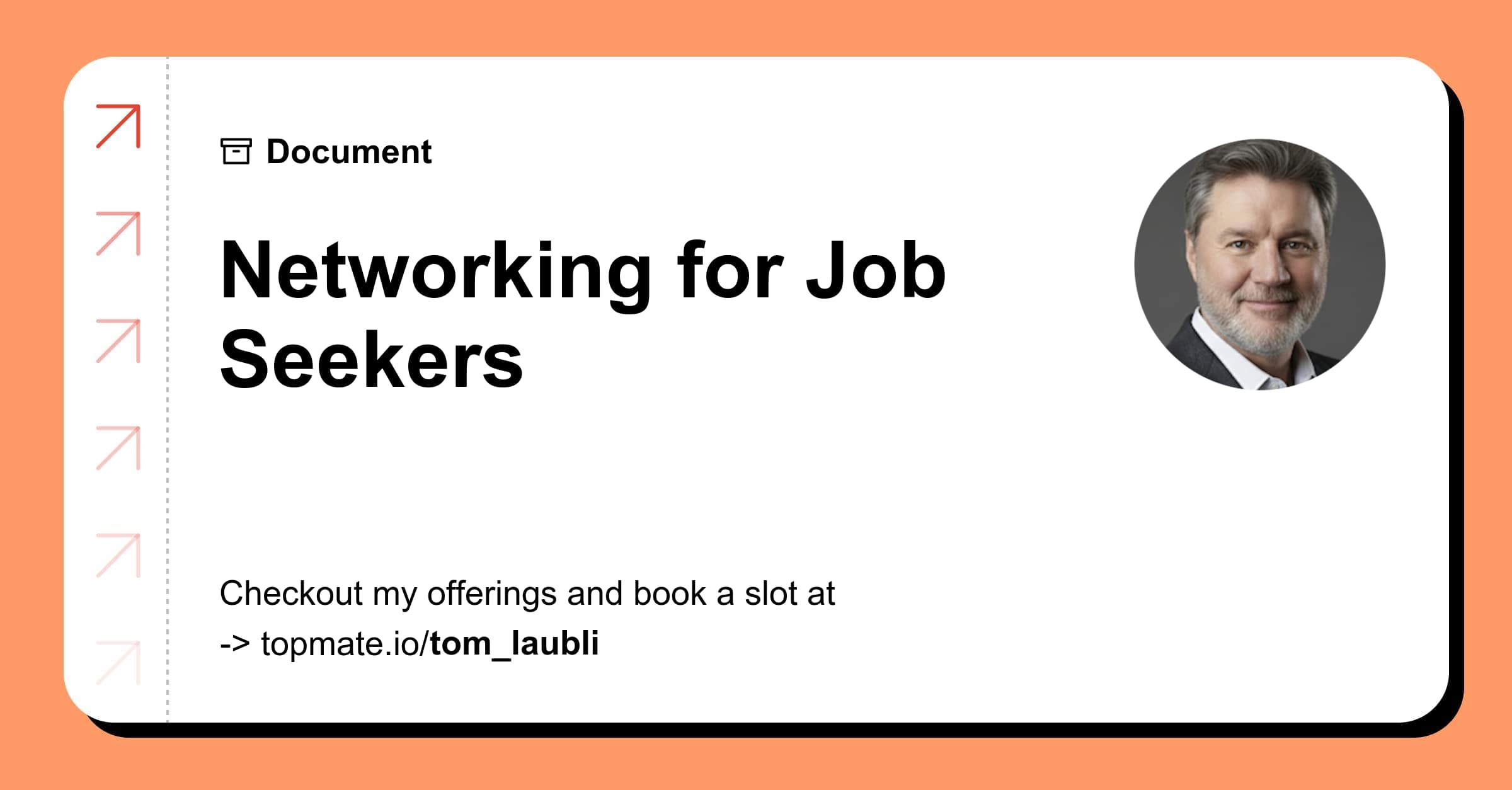
I have just this month developed a book - recipe - guide - kit - field manual on the topic of Networking for Job Seekers. Click on the link, and at checkout apply discount code LADDER for 100% off - so you get this resource for free.
It is a step by step guide to avoiding the black hole of applying blindly to jobs online - building your contacts and network so you can super charge your job search and increase your chances of getting to the interview.

The Bottom Line
Ferrazzi's entire philosophy boils down to this: "Real networking is about finding ways to make other people more successful"
For analysts trained to believe the work speaks for itself, this feels uncomfortable. But invisibility is worse than failure.
Your technical skills got you here. Relationships will get you to the next level, but only if you build them before you need them, give before you take, and operate from generosity instead of scorekeeping.
The club isn't closed. You just have to start showing up.
Best,
Tom.
Resources:
Never Eat Alone by Keith Ferrazzi (Expanded and Updated edition)
Relationship Action Plan template: keithferrazzi.com
Know one teammate who’s drowning in rework or worried AI is eating their job? Forward this to them—you’ll help them climb and unlock the new referral reward: the Delta Teams Playbook, your crisis-mode toolkit when the wheels come off.
Not on The Analytics Ladder yet? You’re missing the brand-new 90-Day Analytics Leadership Action Kit. It’s free the moment you join—your step-by-step playbook to win trust in 14 days, build a system by day 45, and prove dollar impact by day 90.
Disclaimer: Some of the articles and excerpts referenced in this issue may be copyrighted material. They are included here strictly for review, commentary and educational purposes. We believe this constitutes fair use (or “fair dealing” in some jurisdictions) under applicable copyright laws. If you wish to use any copyrighted material from this newsletter for purposes beyond your personal use, please obtain permission from the copyright owner.
The information in this newsletter is provided for general educational purposes only. It does not constitute professional, financial, or legal advice. You use this material entirely at your own risk. No guarantees, warranties, or representations are made about accuracy, completeness, or fitness for purpose. Always observe all laws, statutory obligations, and regulatory requirements in your jurisdiction. Neither the author nor EchelonIQ Pty Ltd accepts any liability for loss, damage, or consequences arising from reliance on this content.
Visit our website to see who we are, what we do. | |
Our blog covering the big issues in deploying analytics at scale in enterprises. |
Social Arbitrage: Your Secret Leverage